Junsheng Construction Decor Materials Co., Ltd.

Interior and Exterior Material Selection for Extreme Cold Regions: Why Flexible Stone Performs Better in High-Latitude Low-Temperature Conditions
Upload Time:
Jun 04, 2026
Overseas engineering companies, building material wholesalers and regional distributors have long faced a common industry challenge. General stone imitation materials that perform stably in temperate regions frequently crack, whiten, peel and age prematurely when used for interior and exterior projects in extreme cold zones. For B2B contractors and suppliers, appearance and low cost are never the primary selection criteria. The core value lies in whether a material is engineered for extreme cold working conditions and capable of stable large-scale engineering application.
From the perspective of professional B2B material selection, project implementation and wholesale distribution, this article systematically analyzes the key selection standards for interior and exterior decoration in high-latitude extreme cold regions. It elaborates on the unique technical advantages of Flexible Stone in adapting to harsh low-temperature environments, providing reliable, project-oriented technical references for global engineering firms, building material wholesalers and regional dealers.
1. Overlooked Harsh Working Conditions for Cold-Region Interior & Exterior Projects
Many procurement and construction teams hold a conventional misunderstanding that only exterior materials require high-level cold resistance, while interior decorative surfaces face low environmental stress. However, massive project data and laboratory simulation tests prove that interior and exterior spaces in extreme cold regions generate continuous hidden fatigue damage through long-term low-temperature freezing, frequent temperature cycling and repeated condensation freeze-thaw erosion. These persistent invisible stresses make cold-region decoration far more demanding than ordinary temperate projects, resulting in high after-sales risks and reputational losses for engineering and distribution businesses.
Extreme cold regions such as Russia and Northern Europe feature three unique harsh working conditions that eliminate most conventional decorative materials from qualified engineering solutions:
1. Long-term deep freezing environment: The extreme cold season lasts up to six months per year. Building wall substrates remain frozen at sub-zero temperatures for a long time and cannot be fully neutralized by indoor heating, leaving decorative surfaces under continuous cold shrinkage stress.
2. Intense temperature cycle fatigue: Sharp temperature differences between freezing outdoor climates and constant indoor heating create daily thermal expansion and contraction. Decorative surfaces endure frequent cyclic stress, gradually leading to structural damage and cracking.
3. Invisible condensation and freeze-thaw erosion: Extreme indoor-outdoor temperature differences generate invisible wall condensation. Day-and-night freeze-thaw cycles continuously erode decorative substrates and adhesive layers, causing hidden aging, peeling and structural deterioration.
Such long-term and invisible environmental losses are the fundamental reason why traditional stone, cement-based finishes and ordinary flexible veneers suffer batch quality failures in cold-region projects. These critical factors must be prioritized during professional B2B material selection.
2. Technical Deficiencies of Conventional Decorative Materials in Cold-Climate Engineering
Based on years of overseas engineering supply experience and systematic laboratory verification, mainstream conventional decorative materials present obvious technical limitations in extreme cold environments, leading to high after-sales rates and unstable project performance in high-latitude regions.
2.1 Rigid Stone / Cement / Gypsum Substrates
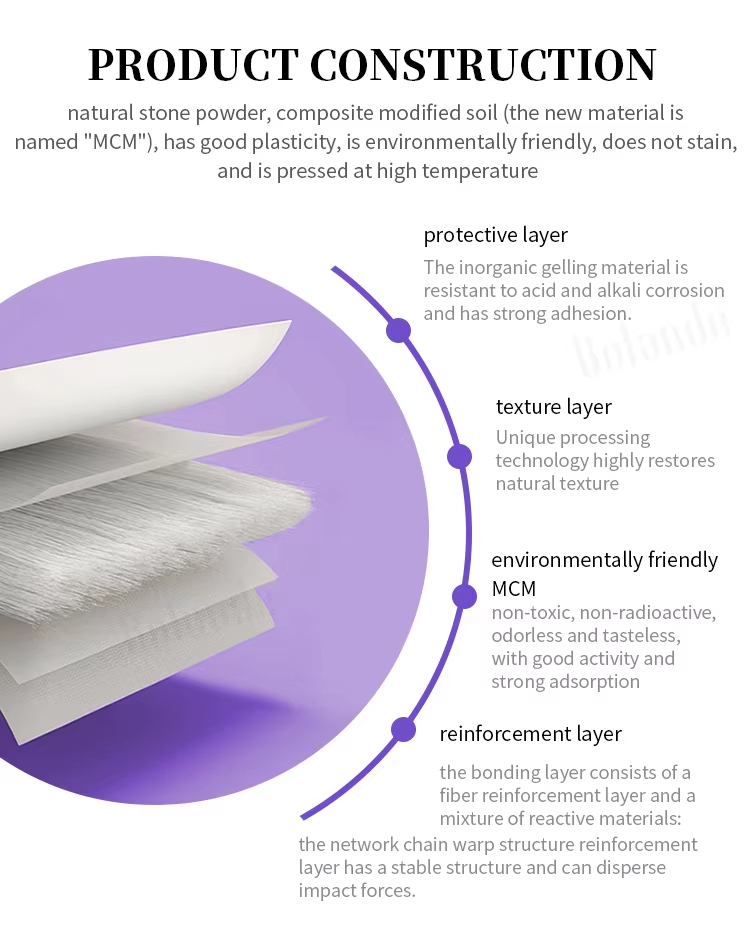
Rigid decorative materials have no thermal deformation tolerance. At low temperatures, they become extremely hard and brittle. Under repeated temperature fluctuations in cold regions, they easily develop surface cracks, joint fractures and edge chipping. With a heavy weight of over 30kg/㎡, these materials impose excessive load on thermal insulation walls and prefabricated building structures widely used in cold climates. Increased wall deformation further accelerates surface damage, making rigid materials unreliable for long-term interior and exterior commercial, hospitality and residential projects in extreme cold zones.
2.2 Ordinary General-Grade Flexible Stone
Widely circulated in the building material trade, ordinary flexible stone is formulated for temperate climates and has inherent low-temperature performance limitations. Lab tests verify its stable working threshold is only -18℃ to -22℃. Once the ambient temperature drops below -25℃, its molecular structure locks completely, losing all flexibility and ductility. Minor wall deformation or construction vibration will trigger batch cracking, delamination and peeling.
This is a vital industry truth for B2B buyers: general flexible stone is only suitable for temperate and mild cold areas and cannot support large-scale interior and exterior projects in Russia and other high-latitude extreme cold markets. Most project failures and after-sales losses result from mismatched material performance and actual cold-region working conditions.
2.3 Condensation Freeze-Thaw Deficiencies and Low-Temperature Adhesion Failure
Recurring condensation and freeze-thaw cycles in cold-region interior and exterior spaces erode porous substrates and conventional adhesive layers, causing powdering, whitening and hollow walls. Low temperatures significantly weaken the activity of ordinary glues and cement mortar, increasing the risk of hollowing and peeling. These problems lead to difficult project acceptance, high rework costs, compensation risks and damaged market credibility for engineering companies and regional distributors.
3. Flexible Stone: Engineered Performance Optimized for Extreme Cold Engineering Scenarios
Abandoning universal low-grade mass-produced formulas, we focus on the actual working conditions of high-latitude cold-region engineering projects. Through hundreds of simulated environment tests including extreme temperature cycling, freeze-thaw aging, low-temperature bending and adhesive durability tests, we continuously optimize material formulas to achieve superior stability tailored for extreme cold scenarios, effectively reducing after-sales risks and operational costs for B2B engineering and distribution clients.
3.1 Modified Cold-Resistant Polymer Structure Prevents Low-Temperature Brittleness
By optimizing the molecular ratio of soft and hard segments, Flexible Stone successfully withstands extreme temperature cycling tests ranging from -60℃ to 60℃. Under sub-zero extreme cold, the material retains stable flexibility and ductility without hardening, brittling or molecular locking. It naturally adapts to wall thermal expansion and contraction, fundamentally eliminating cracking, edge chipping, deformation and aging for both interior and exterior applications. This outstanding stability perfectly suits long-term commercial, public and residential decoration projects in Russia, Northern Europe and other extreme cold regions.
3.2 High-Density Closed-Cell Structure Solves Freeze-Thaw & Condensation Problems
Featuring an integral high-density closed-cell structure, the material achieves extremely low water absorption, effectively blocking invisible condensation penetration in cold climates. It eliminates batch powdering, whitening, delamination and hollowing issues caused by internal freeze-thaw expansion. Equipped with professional low-temperature resistant finishing coating, the surface maintains stable color and texture integrity at -60℃ without film cracking or fading, ensuring long-term unified and high-grade stone-like decorative effects for premium engineering projects.
3.3 Ultra-Light Structure & Stable Low-Temperature Adhesion Reduce Project Risks
Flexible Stone weighs only 1/10 of traditional stone and 1/5 of heavy imitation stone materials. It perfectly matches cold-region thermal insulation walls and prefabricated structures without requiring wall reinforcement, saving construction time and overall project costs. The optimized surface texture adapts to professional low-temperature adhesive systems, maintaining stable bonding performance in long-term freezing environments for both interior and exterior installation. It effectively avoids hollowing and peeling failures, greatly reducing rework pressure and after-sales risks for contractors and distributors, making it ideal for bulk wholesale and large-scale cold-region project rollouts.
3.4 Universal Interior & Exterior Application for High-End Cold-Climate Projects
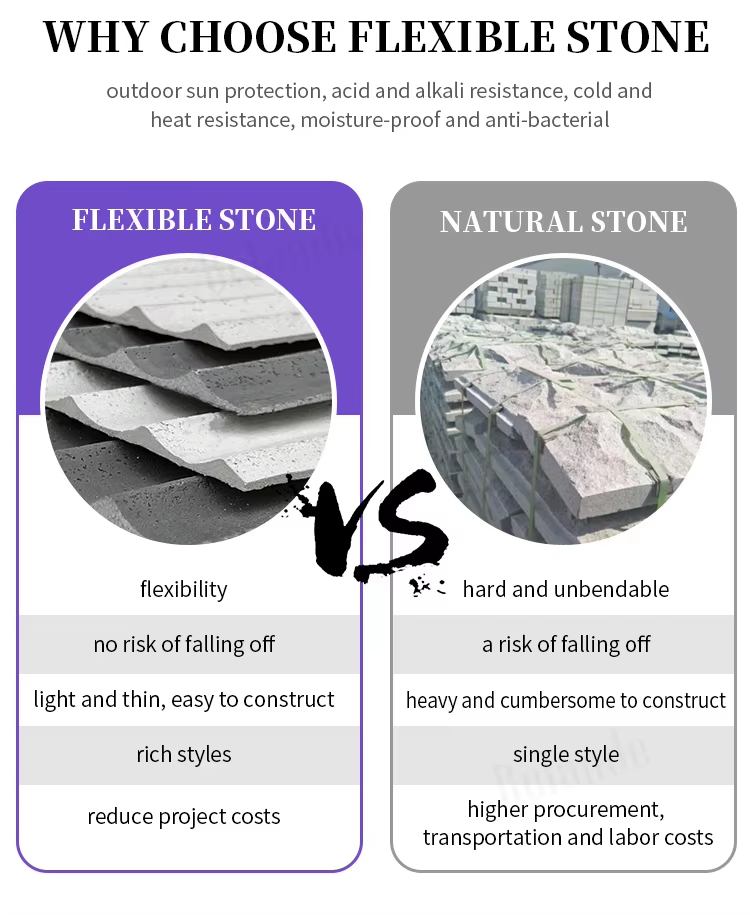
With superior thermal insulation performance compared to traditional stone and cement finishes, Flexible Stone weakens the building cold bridge effect, reducing indoor heat loss and improving uncomfortable cold wall sensations and local condensation. Designed as a universal interior and exterior decorative solution, it serves high-end villas, hotel hospitality spaces, commercial interiors, public buildings, feature walls, building facade renovation and outdoor landscape projects. It enhances project competitiveness with both premium aesthetic performance and long-term structural stability for all cold-region scenarios.
4. B2B Cold-Region Material Selection Logic: Working Condition Adaptability Equals Long-Term Cost-Effectiveness
With years of experience in B2B building material foreign trade, we firmly believe that cold-region engineering selection and channel distribution should prioritize long-term stability and low after-sales risk rather than low unit price.
The core advantage of Flexible Stone lies not in superficial stone imitation appearance, but in professional engineering stability specially optimized for extreme cold interior and exterior working conditions. Most universal decorative materials lack targeted optimization for low temperatures, extreme temperature differences and condensation freeze-thaw cycles, making them unreliable for long-term engineering use. Our products undergo systematic environmental simulation and iterative optimization to steadily support project construction and long-term wholesale distribution in Russia, Northern Europe, North America and high-altitude South American regions, helping B2B clients avoid common cold-region project failures.
B2B building material competition ultimately depends on working condition adaptability and verified reliability. Ordinary temperature stability is the basic industry standard, while extreme cold resistance and long-term durability are the core thresholds for cold-region engineering and channel markets. Focusing on high-latitude interior and exterior decoration pain points, Flexible Stone provides stable, low-risk and professional cladding solutions for global engineering enterprises, building material wholesalers and regional distributors, supporting reliable long-term project delivery and channel development in extreme cold regions.
#FlexibleStone #ColdRegionInteriorMaterials #RussiaBuildingMaterials #HighLatitudeDecoration #EngineeringWallPanel #DurableStoneVeneer #ColdClimateConstruction #BuildingMaterialSupplier #InteriorExteriorRenovation #RussiaInteriorexterior engineering flexible stone, extreme cold resistant wall material, B2B cold climate decorative veneer, high latitude hotel interior & facade decoration, durable engineering wall panel, wholesale flexible stone for cold regions


Contact Us
Tong'an Avenue West, Dongfeng Town, Zhongshan City, Guangdong Province


